The Tritone Piano Method : The Innovative Way to Learn Piano
I always ask new transferring students to play a few songs from memory. I may also ask this question: “How many songs can you play from memory right now?”
I believe repertoire capability reveals the true level of musicianship. If a student can play many songs from memory, this means he/she has a very good understanding of what is going on with those songs, along with a good ear to capture their structure. If the student has been playing piano more than 3 years, but cannot play more than a couple of songs from memory, there will be long way to go back to the very basics in order to re-learn, with new tools to develop good ears. This can sometimes be a hard challenge for some, as their mind is set to one way of learning, and not comfortable with a new approach.
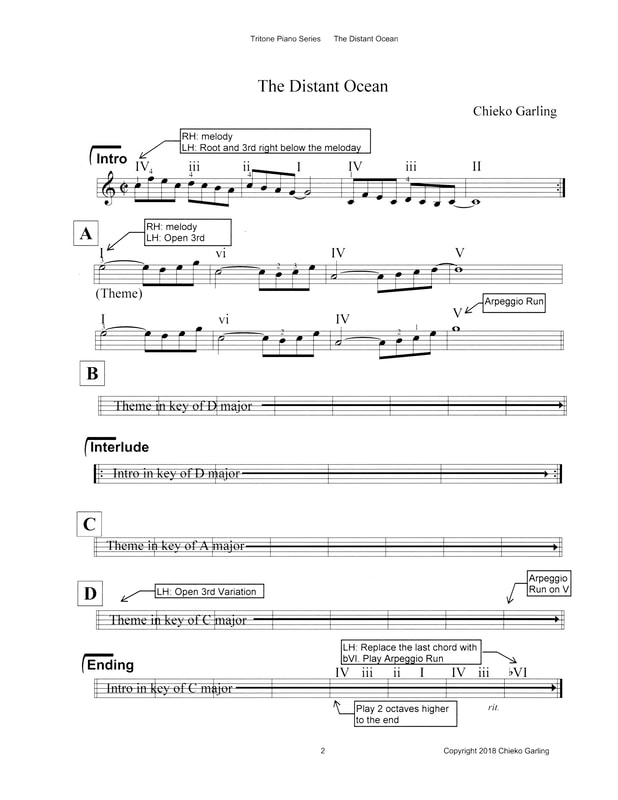
I designed my method books to force my students to think about how compositions are made by studying form, intervals, melody, and harmony progressions. Here is a little example.
The Distant Ocean by Chieko Garling
Lead Sheet
The lead sheet indicates melody segments with its composition map. In this example, one segment is 4 measures, and another segment is 8 measures. The harmony progressions are indicated with Roman numerals, as our students are familiar with them from our method books. Roman numeral concept is very important to develop good ears. In our method books, students are required to practice in 6 different keys starting from the very beginning.
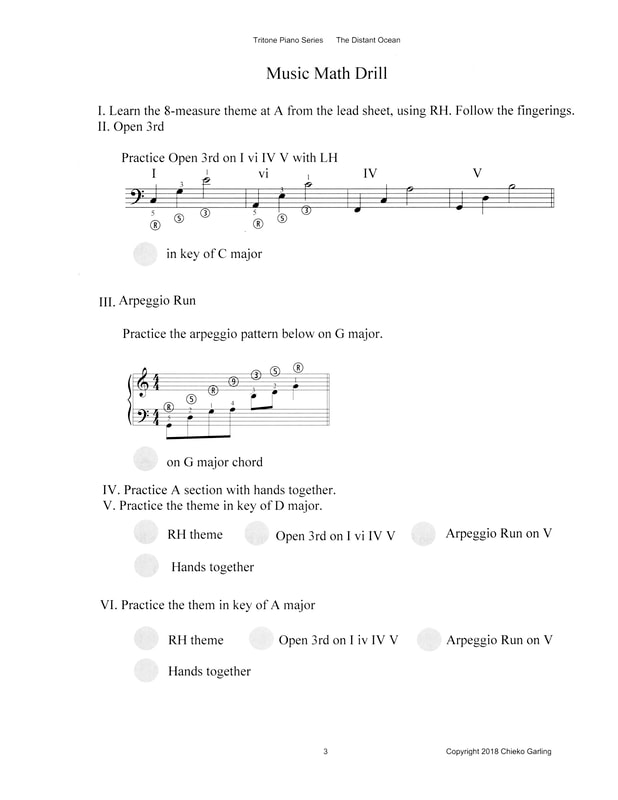
Music Math Drill
This section directs students how to learn the piece step by step. Typically, it is in this order:
1. Practice the melody only. In this example, the melodies are supposed to be played by the right hand in C. 2. Practice the left hand harmony progressions with the indicated arrangement. This example uses the “Open 3rd” shape, which appears in method book five of the Tritone Piano Method. 3. Practice with both hands together in original key, and transpose into few different keys. In this example, the original is in C, and students have to practice in the key of D and A. By now, our students who use the method book know how to transpose with ease. 4. Put everything together to construct the piece with an intro and ending, following the form indicated in the lead sheet. *The grey circles are for smilie stickers for lessons.
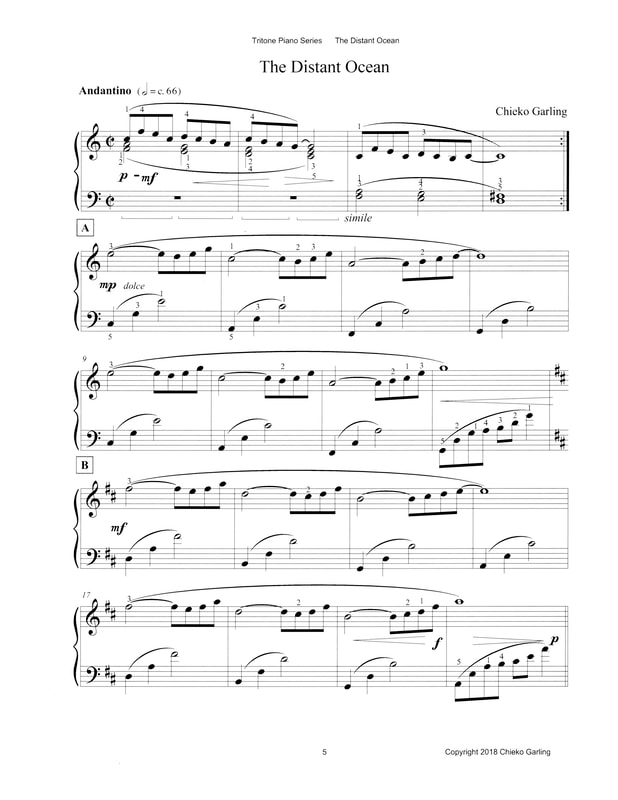
The Traditional Piano Music
Use this section to complete the piece with dynamics and expressions.
I do not encourage our students to learn the piece from the third section. Every single note is written on paper, without offering any thought about the music itself, like harmonic and melodic movements. It might be a lot quicker and easier to learn the piece, and most people may prefer this route. However, when learning music, a shortcut is not necessarily the better path. Most of the time, a little detour gives better results in the end. My students who learned this piece using these steps can remember the song for many years to come without practicing the piece.